

Do you notice that your child often struggles with questions that have figures? Try this question!
Figure 1 shows a rectangular tile with a perimeter of 14 cm. Figure 2 is formed using 5 such tiles. Find the perimeter of Figure 2.
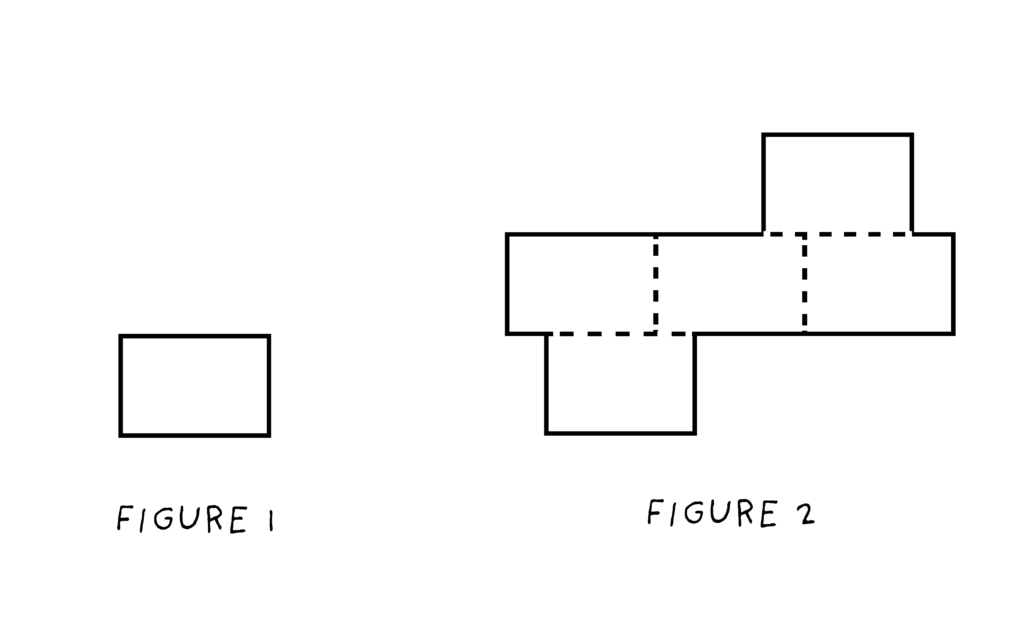
Source: 2021 PSLE paper
Your child might probably have difficulties visualising. If your child is stuck on this question, then it’s important to develop their visual skills. Well-developed visual skills help them to manipulate visual images in their heads which is important for solving questions of this nature. But do not worry, this is a skill that can be developed.
Visual thinking is a way to organize and communicate your thoughts in a simpler way. It stimulates our brains and enhances the way we see and understand things around us. ‘’A picture is worth a thousand words’’. Visual thinking is often described as translating words into visual images. This helps us to understand and remember information better. With well-developed visual skills, students are able to summarise and translate textual information using visual images. For instance, using tables, models or timelines to summarise and represent information given in a math word problem makes it easier to solve it.
One good way to develop this skill is through visual puzzles. It helps to improve non-verbal reasoning and logical thinking as well. It will aid your lateral and creative thinking and boost your ability to solve problems differently. This is a vital skill we would want to develop in our kids. Kids with well-developed visual skills would be able to look at problems from different perspectives. It would also enhance their ability to think flexibly. Most importantly they would be able to solve problems without giving up easily. We also emphasise and share strategies to develop this skill in our Higher Order Mathematical Skills certificate course.
Try solving the visual puzzle below from Dr Gareth Moore’s book on Visual thinking.
Which of the options, A to D, represents a view of the first 3D object when seen from the direction of the arrow?
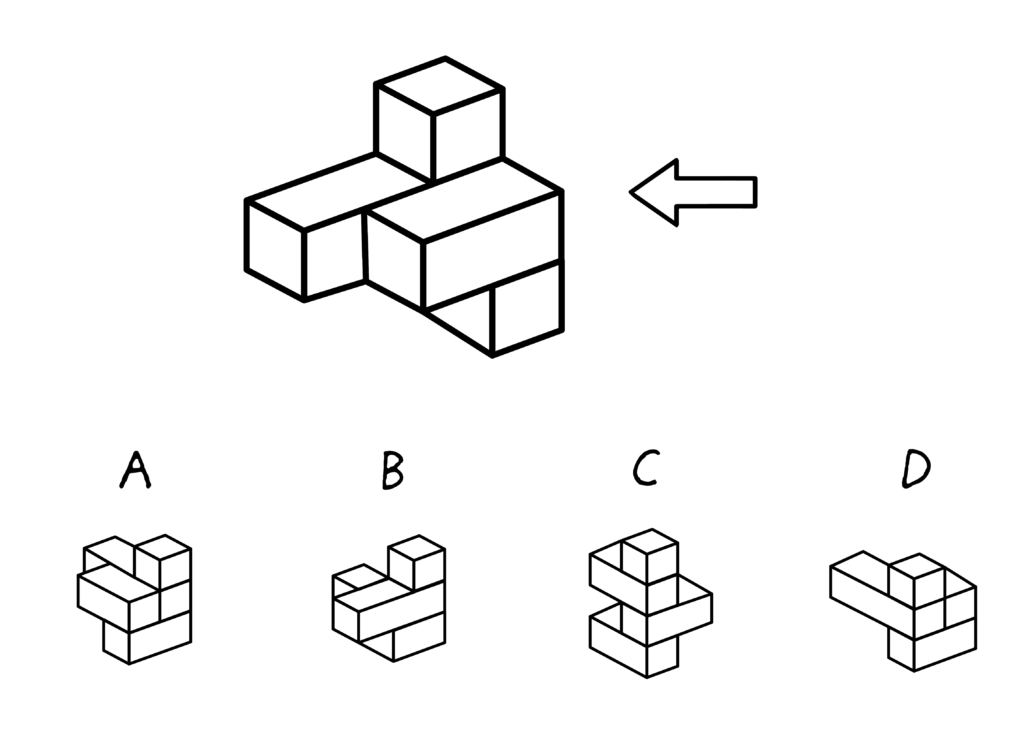
Source: book by Dr Gareth Moore on Visual thinking, Puzzle 36
Try occupying your kids with such activities. It can be done on the go, or while waiting for their lesson or food etc, anywhere, anytime easily.
Written by Rebecca Shalinah, Associate Lecturer and Lead Educational Therapist – RETA Associate Fellow


